Does this asset move on its own — or is it riding something bigger?
The new Correlation Engine correlates any symbol against the whole tradable universe — roughly 9,000 instruments across crypto, stocks, indexes and precious metals — in a single pass. It returns what the asset follows and what it opposes, across five timeframes at once, recomputed every five minutes as new prices arrive.
August 31, 2026 — Datapipesoft today released the Correlation Engine on CryptoOracle, its AI-assisted trading platform. It answers one of trading’s oldest questions — does this asset move on its own, or is it just riding something bigger? — in under a second instead of an afternoon of chart-flipping.
The question every chart hides
Most of a small coin’s move is usually just beta to Bitcoin — if the correlation with the majors is high, you are really trading BTC with extra volatility, and the coin’s “own story” matters far less than the chart suggests. The same logic runs through every asset class: silver shadows gold with higher beta, tokenized tech stocks shadow the Nasdaq names behind them, index futures shadow each other. Knowing which trade you are actually in is the first step of any analysis — and until now it meant exporting candles into spreadsheets, pair by pair.
9,000 symbols. One pass. Under a second.
The engine runs directly on the price series CryptoOracle’s pipelines already keep in memory — no external API calls, no waiting on a data vendor. One request fetches the entire universe in a single round trip, and one vectorized computation correlates every candidate against the target at once. Correlation is always computed on returns, never raw prices: trending price series produce inflated, meaningless correlations, and the engine refuses to make that classic mistake for you.
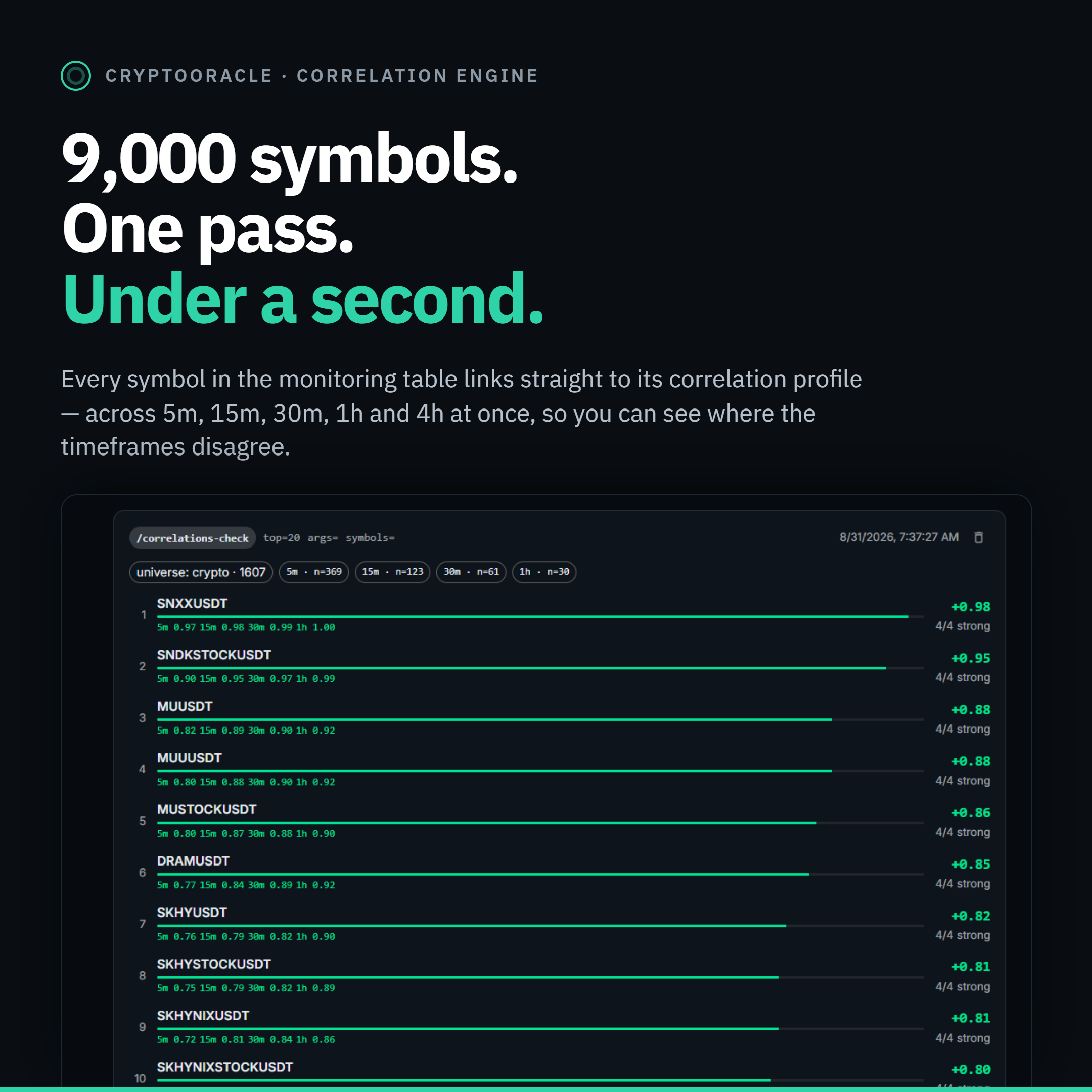
Every symbol in the monitoring table links straight to its correlation profile. Results are cached and recomputed every five minutes — the market’s own rhythm — so the picture on screen is never stale and never wasteful.
What it opposes, not just what it follows
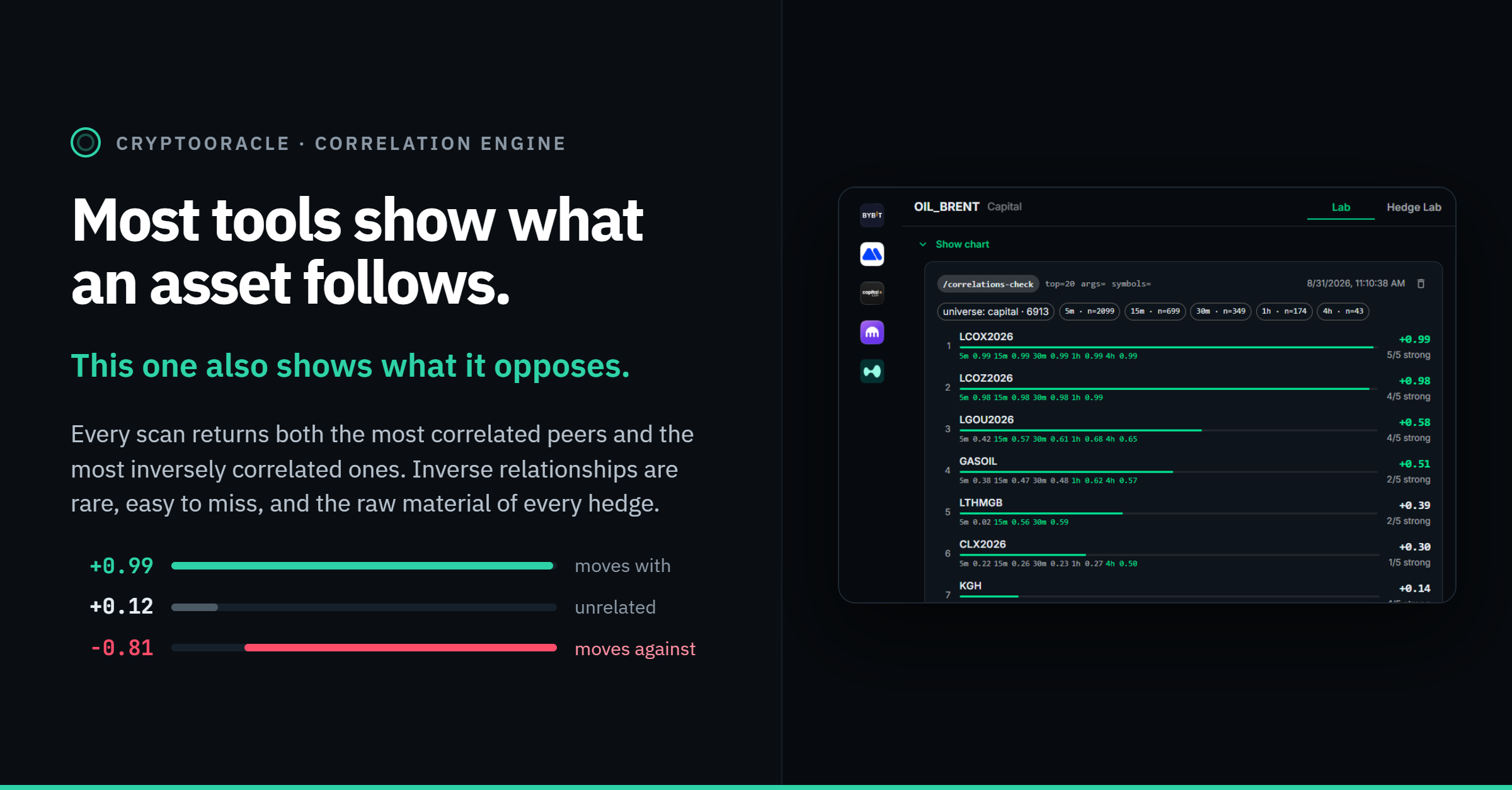
Most tools show you what an asset moves with. The Correlation Engine also shows what it moves against. Every scan returns both the most correlated peers and the most inversely correlated ones — the names that tend to go the other way. Inverse relationships are rare, easy to miss, and among the most valuable signals a portfolio can have: they are the raw material of hedges, and the early warning that a “diversified” book is really one trade wearing several tickers.
Five timeframes, one screen
A single scan reports correlation across 5-minute, 15-minute, 30-minute, hourly and 4-hour windows at once, with daily and weekly coverage on top. Short windows show trading coupling — is this tick-by-tick beta to the market leader right now? Long windows show regime coupling — do these two live in the same macro trade? The interesting stories are where the timeframes disagree: a pair that drifts together on the daily chart but decouples intraday behaves very differently from one glued together on every scale. The engine puts that disagreement on one screen instead of leaving it for you to discover in a live position.
History that doesn’t evaporate
Correlations are not constants — they shift with market regimes, and a coefficient without a date is worthless. The engine is built on extended price retention: a full week of 5-minute history for fast crypto markets and a dedicated daily-close series going back a year and more for every symbol. Every figure is measured, timestamped and reproducible, so the same relationship can be re-checked across regimes to see whether it held, strengthened, or quietly broke down. A drop in a normally-high correlation is often the most interesting signal of all — it means something idiosyncratic is finally happening.
Every asset class in the same scan
Because CryptoOracle already streams prices from crypto exchanges alongside stocks, indexes and precious metals, the engine works across asset classes, not just within them. Check a small cap against Bitcoin and its narrative peers; check gold against silver, platinum and palladium; check a tokenized stock against the index it shadows. Cross-market relationships that normally require stitching together separate data vendors are one query here.
The Correlation Engine is live now for all CryptoOracle users. A second phase — automatic peer discovery that groups assets by industry and narrative (“correlates 0.8 with meme, 0.3 with AI”) — is already in development.